30 abril 2014
29 abril 2014
28 abril 2014
27 abril 2014
Portugal e portugueses (e revoluções) em 1809
THE study of modern history has been, during a long course of years, greatly neglected in the generality of public schools; but it now begins to be regarded (as indeed it ought always to have been) as an object of the greatest importance. In England, particularly, it constitutes one of the principal branches of both public and private education.
The abbé de Vertot’s History of the Revolutions of Portugal has been always esteemed equally entertaining and instructive; and as such more especially calculated for the use of young people. The late events in that country has made it doubly interesting, and nothing now seems wanting to complete so excellent a performance, but to continue the narrative to the present period. (...)
The recent departure of the family of Braganza from Lisbon, and their arrival in Brazil, has called for the attention, and interested the minds of every one. We have therefore been tempted to give a slight sketch of a country which is now become an object of no small curiosity: to which we have added, for the satisfaction of those readers who may be desirous of a more minute description, a list of the principal authors who have made this beautiful, though remote part of the new world, the particular object of their attention. (...)

THE kingdom of Portugal makes part of the great extent of country called Spain; most of its provinces bear the names of the different kingdoms into which it is divided: that of Portugal lies to the West of Castille, and on the most western coast of Europe; it is only a hundred and ten leagues in length, and its greatest breadth does not exceed fifty. The soil is fertile, the air wholesome, and the heat of the climate is tempered by refreshing breezes and fruitful showers. The crown is hereditary, and the monarch absolute. The formidable tribunal of the Inquisition is regarded by this prince as the safest and most useful means of forwarding his political views, and as such, employed by him with the greatest success. The Portugueze are naturally fiery, proud, and arrogant, greatly attached to their religion, though more superstitious than truly devout; they regard almost every event as a prodigy, and not only persuade themselves, but endeavour to persuade others, that they are the peculiar favourites of Providence, which never fails to protect them in the most extraordinary manner.
Deste The History of the Revolutions of Portugal
The abbé de Vertot’s History of the Revolutions of Portugal has been always esteemed equally entertaining and instructive; and as such more especially calculated for the use of young people. The late events in that country has made it doubly interesting, and nothing now seems wanting to complete so excellent a performance, but to continue the narrative to the present period. (...)
The recent departure of the family of Braganza from Lisbon, and their arrival in Brazil, has called for the attention, and interested the minds of every one. We have therefore been tempted to give a slight sketch of a country which is now become an object of no small curiosity: to which we have added, for the satisfaction of those readers who may be desirous of a more minute description, a list of the principal authors who have made this beautiful, though remote part of the new world, the particular object of their attention. (...)
THE kingdom of Portugal makes part of the great extent of country called Spain; most of its provinces bear the names of the different kingdoms into which it is divided: that of Portugal lies to the West of Castille, and on the most western coast of Europe; it is only a hundred and ten leagues in length, and its greatest breadth does not exceed fifty. The soil is fertile, the air wholesome, and the heat of the climate is tempered by refreshing breezes and fruitful showers. The crown is hereditary, and the monarch absolute. The formidable tribunal of the Inquisition is regarded by this prince as the safest and most useful means of forwarding his political views, and as such, employed by him with the greatest success. The Portugueze are naturally fiery, proud, and arrogant, greatly attached to their religion, though more superstitious than truly devout; they regard almost every event as a prodigy, and not only persuade themselves, but endeavour to persuade others, that they are the peculiar favourites of Providence, which never fails to protect them in the most extraordinary manner.
Deste The History of the Revolutions of Portugal

26 abril 2014
25 abril 2014
Da irrelevância dos partidos políticos na economia em Portugal
In short--political differences in ideology and praxis between the parties are irrelevant.
In the last forty years, periods of economic growth, stagnation, and recession have occurred in equal measure irrespective of which party held the power. An examination of these economic periods reveals that any one political party's influence is no more or less beneficial than any other. (...)

One consequence of Portugal's "tribalism politics" is that the current politics disproportionately focuses resources, including political energy, on short-term policy goals that can be implemented within the potentially shortened timeframe between election cycles. Uncertainty about term length and the desire to maintain political favor within a shorter timespan undermines the development of sustainable long-term goals (...)
There are at least three observations that illustrate the failures of Portugal's political system in developing sustainable, long-term goals. The historical regularity of political-economic crises, which in recent times are occurring with greater frequency, is one such observation. From 1974 to 2003 Portugal faced negative growth in 9-10 year intervals (1974/1975 - 1983/1984 - 1992/1993 - 2002/2003). After 2003, however, the negative growth time interval occurred at the fifth year (in 2008/2009). Secondly, since 1976, all major institutional innovations adopted by Portugal originated from without the country. The principle examples include, the initiation of negotiations with the European Economic Community (EEC) in 1977, the intervention by the IMF in 1978 and 1983, the full adoption of EEC regulations in 1985, adoption of the EURO in 2002, and another IMF intervention in 2011. Finally, the widening of the income inequality gap as illustrated by the fact that in 1976 the richest 0.1% gathered 1.3% of the country's income, but three decades later (2005) this value had already nearly doubled to 2.5%. (...)
If key development variables are indifferent to political parties' differences, it follows that the political process should be based on a non-confrontational, cooperative process grounded in elevated political ethics of the common--not the tribal--good.
Deste "Four Decades after the 'Third Wave of Democratization' and the Irrelevance of Political Parties' Differences in Portugal: 1974-2014"
In the last forty years, periods of economic growth, stagnation, and recession have occurred in equal measure irrespective of which party held the power. An examination of these economic periods reveals that any one political party's influence is no more or less beneficial than any other. (...)
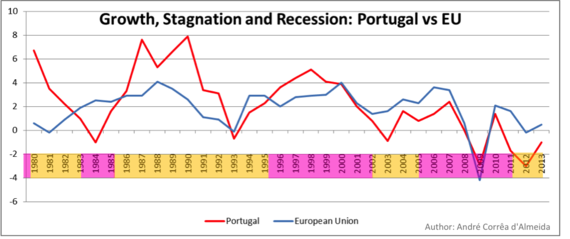
One consequence of Portugal's "tribalism politics" is that the current politics disproportionately focuses resources, including political energy, on short-term policy goals that can be implemented within the potentially shortened timeframe between election cycles. Uncertainty about term length and the desire to maintain political favor within a shorter timespan undermines the development of sustainable long-term goals (...)
There are at least three observations that illustrate the failures of Portugal's political system in developing sustainable, long-term goals. The historical regularity of political-economic crises, which in recent times are occurring with greater frequency, is one such observation. From 1974 to 2003 Portugal faced negative growth in 9-10 year intervals (1974/1975 - 1983/1984 - 1992/1993 - 2002/2003). After 2003, however, the negative growth time interval occurred at the fifth year (in 2008/2009). Secondly, since 1976, all major institutional innovations adopted by Portugal originated from without the country. The principle examples include, the initiation of negotiations with the European Economic Community (EEC) in 1977, the intervention by the IMF in 1978 and 1983, the full adoption of EEC regulations in 1985, adoption of the EURO in 2002, and another IMF intervention in 2011. Finally, the widening of the income inequality gap as illustrated by the fact that in 1976 the richest 0.1% gathered 1.3% of the country's income, but three decades later (2005) this value had already nearly doubled to 2.5%. (...)
If key development variables are indifferent to political parties' differences, it follows that the political process should be based on a non-confrontational, cooperative process grounded in elevated political ethics of the common--not the tribal--good.
Deste "Four Decades after the 'Third Wave of Democratization' and the Irrelevance of Political Parties' Differences in Portugal: 1974-2014"
40 anos depois...
- temos um presidente da República "salazarista", envolvido em negócios nunca explicados, que vive acima das possibilidades do Palácio de Buckingham e se esquece, até que preencheu ficha na PIDE onde declarava não se dar com a segunda mulher do sogro...;
- temos uma presidente da Assembleia da República que "nunca foi tida como muito sã da cabeça";
- temos uma Assembleia da República com um "cheiro muito forte e tóxico" e uns políticos sacrificados pelos cortes salariais (desde 2011...);
- temos partidos que não querem os seus deputados em exclusividade na Assembleia da República;
- temos eurodeputados de que só se ouve falar quando se candidatam e não prestam contas ao País do que se passa nas instituições europeias;
- temos autarquias com uma péssima despesa pública, algumas das quais até ameaçam fechar blogues por publicarem informação pública;
- temos um interior que é como os "guetos nazis";
- temos uma máquina fiscal que é a nova "SS nazi" ("Lutar contra a carga fiscal é como militar na Resistência"...) ou a nova PIDE (decide sem sentença judicial, mesmo que apenas exista "suspeita de crime"...), n'"um Estado que utiliza o fisco no limite das liberdades e no limite dos direitos: inverte o ónus da prova e que trata das pessoas de uma maneira inaceitável. Há uma cultura de prepotência perante o cidadão comum. Mais, há até a entrada num domínio perigoso: Se hoje houvesse uma polícia política ela nem precisaria de nova legislação, bastava consultar o fluxo de facturas do fisco, para saber o que eu faço o dia inteiro: o que eu como, o que eu consumo. Cruzando com os dados do multibanco, tudo estaria disponível";
- temos um ecossistema político-empresarial e uns burgueses;
- e temos pessoas que denominaram uma revolução porque deram cravos por não terem cigarros.
Nem todos somos lixo, claro que não:
24 abril 2014
Subscrever:
Mensagens (Atom)